
Photo: Autor desconocido / Wikimedia Commons · Public domain · Source
July 30, 1966 · Inglaterra
Wembley 1966: the day England became world champions
On July 30, 1966, with a Geoff Hurst hat-trick and a goal still debated today, England beat West Germany 4-2 at Wembley to win their only World Cup.
- Date of the event:
England were awarded the eighth World Cup on August 22, 1960, at a FIFA congress in Rome, ahead of bids from West Germany and Spain. The tournament was played from July 11 to 30, 1966, with 16 national teams and eight stadiums in seven cities. There was one major absence: all 15 African federations that had entered withdrew in protest because Africa had no direct place at the finals.
The West Germany team in April 1966, three months before the Wembley final.
Photo: Eskil Malmberg / Wikimedia Commons · CC BY 4.0 · Source
The trophy found by a dog
Four months before kick-off, the World Cup had its first drama. On Sunday, March 20, 1966, the Jules Rimet trophy vanished from the stamp exhibition being held at Westminster Central Hall in London. The thief demanded a £15,000 ransom from the chairman of the Football Association, Joe Mears, and a police sting came to nothing. A week later, on March 27, a dog called Pickles sniffed out a package wrapped in newspaper under a hedge outside the home of his owner, David Corbett, on Beulah Hill in south London. It was the trophy. Just in case, the FA also secretly commissioned a replica from the silversmith George Bird.
That World Cup also introduced the first mascot in the history of the competition: World Cup Willie, a cartoon lion wearing a Union Jack shirt.
A replica of the Jules Rimet trophy at the National Football Museum in Preston (photo from 2009).
Photo: Wikimedia Commons · Public domain · Source
A tournament of surprises
The competition produced unforgettable results far from London. In Middlesbrough, North Korea beat Italy 1-0 and reached the quarter-finals, where they went 3-0 up against Portugal. Then Eusébio took over, scoring four goals in Portugal's 5-3 win and finishing as the tournament's top scorer with nine. Brazil, the two-time champions, went out in the first round: Pelé was injured in the opening match and, after more brutal fouls against Portugal, was carried off on a stretcher in the 3-1 defeat.
England, managed by Alf Ramsey and captained by Bobby Moore, came through their group without conceding: they drew 0-0 with Uruguay and beat Mexico 2-0 and France 2-0. Against the French, Jimmy Greaves, the star of the attack, was injured, and his place went to Geoff Hurst, who until then had watched from the bench. Hurst scored the only goal of the quarter-final against Argentina, a match remembered for the sending-off of Argentina captain Antonio Rattín, who refused to leave the pitch. In the semi-final, Bobby Charlton scored both goals in a 2-1 win over Portugal. For the final, Ramsey kept Hurst in the side, even though the press wanted Greaves back.
An England shirt from the 1966 World Cup, on display at the National Football Museum (photo from 2025).
Photo: Hmickey / Wikimedia Commons · CC BY-SA 4.0 · Source
The final
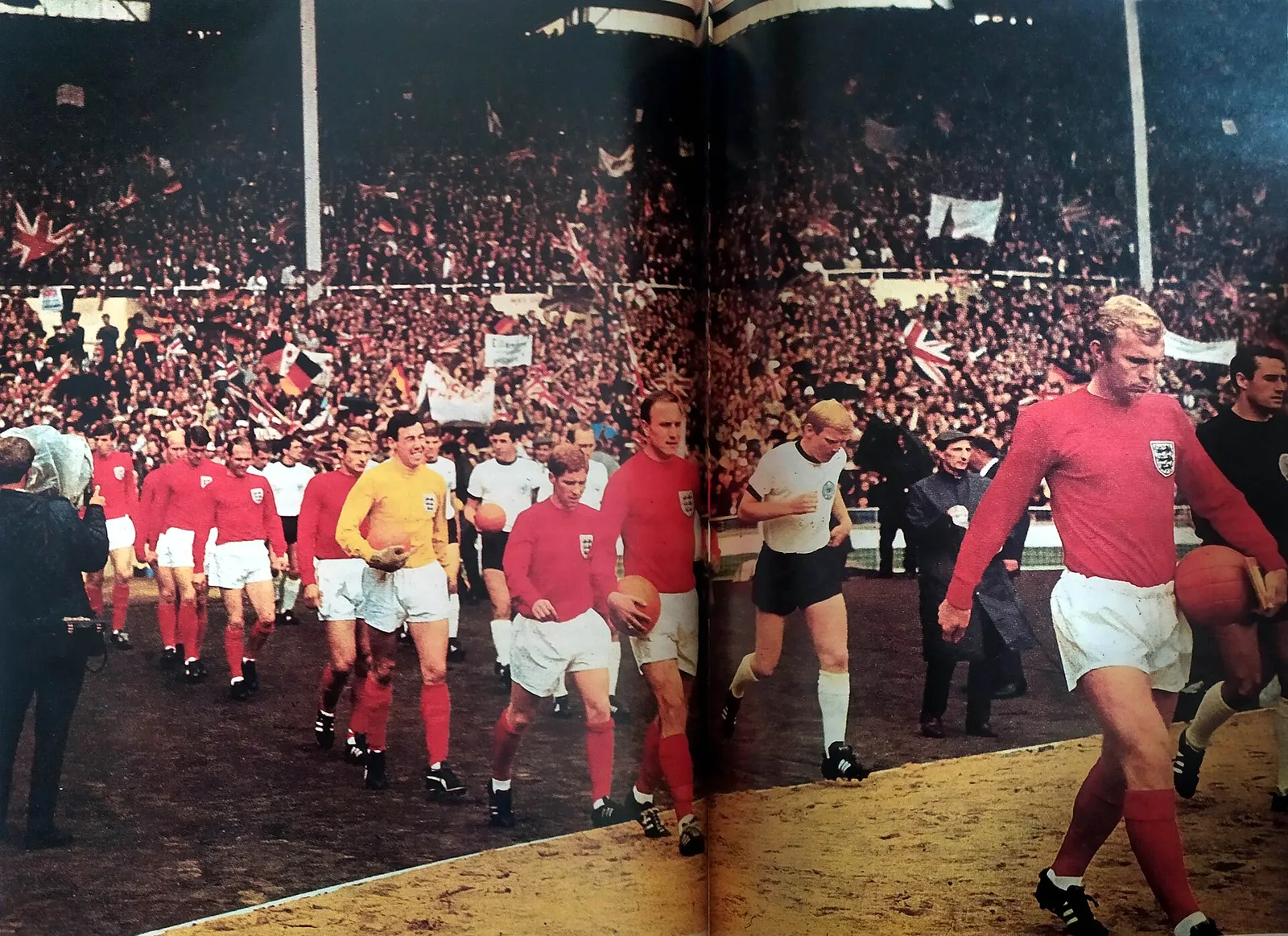
On Saturday, July 30, 1966, in front of 96,924 spectators at Wembley, England and West Germany played the final with the Swiss Gottfried Dienst as referee. Because both teams wore white, England lost the toss and played in their red shirt, which has been tied to that afternoon ever since. The ball was an orange Slazenger, chosen so it would show up better on black-and-white televisions.
Helmut Haller put the Germans ahead after 12 minutes and Hurst equalised with a header shortly afterwards, from a Moore cross. Martin Peters made it 2-1 in the 78th minute and that seemed to be that, but Wolfgang Weber levelled in the final minute and the match went to extra time.
In the 101st minute came the most debated moment in World Cup history. Hurst shot, the ball struck the underside of the crossbar, bounced down and came out. Dienst consulted his linesman, the Soviet Tofiq Bahramov, who signalled a goal. Film analysis and computer simulations suggest the whole ball did not cross the line; a 2016 study concluded the opposite. With time up, Moore played a long pass, Hurst ran towards goal and finished with his left foot to make it 4-2. It was the first hat-trick in a World Cup final.
Photo: Wikipedia.com · Author's permission · Source
Moore, the Queen and the trophy
In the royal box, before approaching Queen Elizabeth II, Moore wiped his muddy hands on the velvet cloth draped over the balcony. He then received the trophy and his teammates carried him on their shoulders. Haller took the match ball home to Germany, following the custom that the scorer of the first goal keeps it.
More than 32 million people in the United Kingdom watched the final on television. It was the last World Cup final broadcast entirely in black and white, and it remains England's only world title.
Timeline
FIFA chooses England to host the 1966 World Cup.
The Jules Rimet trophy is stolen from a stamp exhibition at Westminster Central Hall.
Pickles the dog finds the trophy on Beulah Hill, in south London.
The World Cup kicks off in England, with 16 national teams.
Semi-final: Bobby Charlton scores both goals in a 2-1 win over Portugal.
Final at Wembley: England beat West Germany 4-2 after extra time, with three goals from Geoff Hurst.
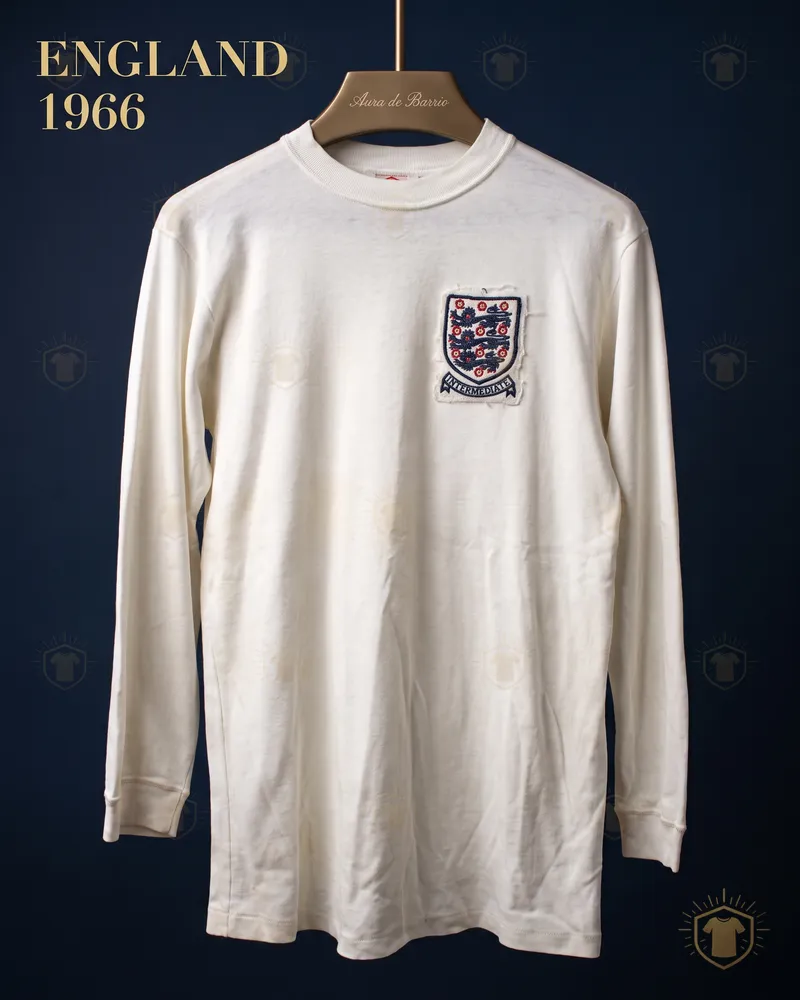
Shirts from those years
From the same era. Not necessarily the one worn that day.
Verified sources
6 sources consulted
- Website. Royal Central: Milestones of a monarch: the Queen presents the World Cup to Bobby Moore View source
- Website. National Football Museum: When football came home: the 60th anniversary of 1966 View source
- Website. Wikipedia (en): 1966 FIFA World Cup final View source
- Website. Wikipedia (en): 1966 FIFA World Cup Group 1 View source
- Website. Wikipedia (en): 1966 FIFA World Cup View source
- Website. Crime+Investigation: How the World Cup trophy was stolen and recovered in 1966 View source
Keep exploring
- TeamsSee the Inglaterra page →
- The stadiumWembley Stadium →
- May 25, 1967 · CelticLisbon 1967: the Glasgow lions who conquered EuropeOn May 25, 1967, with goals from Tommy Gemmell and Stevie Chalmers, Jock Stein’s Celtic came from behind against Helenio Herrera’s Inter in the final in Lisbon and became the first British club to be crowned champions of Europe.
- June 5, 1991 · Colo-ColoColo-Colo 1991: the night Chile won its only Copa LibertadoresOn June 5, 1991, with two goals from Luis Pérez and one from Leonel Herrera, Colo-Colo beat reigning champions Olimpia 3-0 at the Monumental and won the only Libertadores ever claimed by a Chilean club.
- May 20, 1998 · Real MadridAmsterdam 1998: Real Madrid's SeventhOn May 20, 1998, a goal by Predrag Mijatović against Juventus brought the European Cup back to Real Madrid after a 32-year wait.
- July 2, 2008 · Liga Deportiva Universitaria de QuitoLDU Quito 2008: the Cup that reached EcuadorWith a 4-2 win in Quito and a night of penalties at the Maracanã, Liga Deportiva Universitaria became the first Ecuadorian club to win the Copa Libertadores.