

Photo: RED Gol · Author's permission · Source
June 5, 1991 · Colo-Colo
Colo-Colo 1991: the night Chile won its only Copa Libertadores
On June 5, 1991, with two goals from Luis Pérez and one from Leonel Herrera, Colo-Colo beat reigning champions Olimpia 3-0 at the Monumental and won the only Libertadores ever claimed by a Chilean club.
- Date of the event:
On June 5, 1991, in front of 66,517 spectators at the Estadio Monumental in Santiago, Colo-Colo beat Olimpia 3-0 and became champions of South America. To this day it is the only Copa Libertadores won by a Chilean club. Behind that night were a coach shaped in Yugoslavia’s youth system, a squad that brought together several generations of the club, and a 14-match campaign in which the team scored 22 goals and conceded just 8.
Photo: ESPN Deportes · Author's permission · Source
A Croatian coach in Macul
Mirko Jozić, a Croatian coach, already knew Chilean football: in 1987 he had led the Yugoslavia youth team that won the U-20 World Cup in Chile. In 1990 he took charge of Colo-Colo’s first team, which won the Chilean championship that same year and with it earned a place in the following year’s Libertadores.
In goal was Daniel Morón, with Marcelo Ramírez as his backup. Lizardo Garrido, Miguel Ramírez, Javier Margas and Eduardo Vilches made up the back line, and captain Jaime Pizarro, a holding midfielder, was the team’s linchpin alongside Rubén Espinoza, Juan Carlos Peralta and Gabriel Mendoza. In attack, Marcelo Barticciotto, Ricardo Dabrowski, Rubén Martínez, Patricio Yáñez, Luis Pérez and Leonel Herrera took turns. Dabrowski finished as the team’s top scorer in the tournament, with six goals.
Photo: La tercera · Author's permission · Source
Unbeaten in the group
Colo-Colo were drawn in Group 2 with Deportes Concepción, Liga Deportiva Universitaria de Quito and Barcelona de Guayaquil. Their debut came on February 20, the same day the tournament began: a 0-0 draw in Concepción. At the Monumental the team won all three of their matches, 3-1 against Barcelona, 2-0 against Concepción and 3-0 against Liga de Quito, and away from home they added two more draws, 2-2 in Guayaquil and 0-0 in Quito. They finished top of the group, unbeaten, with 9 points, 10 goals scored and 3 conceded.
Photo: La tercera · Author's permission · Source
Lima, Montevideo and a heated night against Boca
In the round of 16 their opponents were Universitario de Deportes. After a 0-0 draw in Lima, Colo-Colo won 2-1 in Santiago with two goals from Rubén Espinoza. In the quarter-finals they faced Nacional of Montevideo: the 4-0 first-leg win at the Monumental proved decisive, because in Montevideo the Uruguayans won 2-0 and it was not enough.
The semi-final against Boca Juniors, who had Gabriel Batistuta in attack, is remembered for reasons both on and off the pitch. At La Bombonera, Boca won 1-0 with a goal from Alfredo Graciani. The return leg was played on May 22 at the Monumental, in front of 64,208 people. Colo-Colo turned the tie around in the second half with goals from Rubén Martínez and Marcelo Barticciotto; Diego Latorre pulled one back for the 3-1 that left the aggregate at 3-2 in the Chileans’ favour.
The ending was chaotic. Punches were thrown between players and people standing by the side of the pitch, and in the middle of the brawl a Carabineros police dog bit Boca goalkeeper Carlos Navarro Montoya. Years later, Navarro Montoya himself admitted that the match would not be played that way today. Latorre remembered it as the most shameful thing he ever experienced on a pitch.
The final against the reigning champions
On the other side stood Olimpia, the toughest opponent they could have drawn. The Paraguayan club, coached by Luis Cubilla, were the reigning champions after winning the 1990 Libertadores, had already won it in 1979, and were reaching their third consecutive final, after losing the one in 1989. Colo-Colo, by contrast, had played only one final before, in 1973.
The first leg was played on May 29 at the Defensores del Chaco stadium in Asunción, refereed by the Uruguayan Ernesto Filippi. It was a tight match that ended 0-0. Near the end, after a clash, Olimpia’s Virginio Cáceres and Colo-Colo’s Rubén Martínez were sent off, so neither could play in the return leg. The Chileans were also without Patricio Yáñez, who missed the final through injury.
The second leg, a week later at the Monumental, was refereed by the Brazilian José Roberto Wright. Luis Pérez settled much of the story very early: he scored twice before the 20th minute. Around the half-hour mark, Olimpia were reduced to ten men when Gabriel González was sent off. Gabriel Mendoza went off injured and was replaced by Leonel Herrera, who five minutes from the end made it 3-0.
For Olimpia it was a bitter night, but their era was already part of history: three consecutive finals between 1989 and 1991 and the 1990 title confirmed that team as one of the greats of those years in South America.
What came next
As champions of South America, Colo-Colo travelled to Tokyo to play the Intercontinental Cup on December 8, 1991 against Red Star Belgrade, the champions of Europe. The Yugoslav side played the entire second half with a man down after Dejan Savićević was sent off, but won 3-0 with two goals from Vladimir Jugović and one from Darko Pančev, in front of more than 60,000 spectators.
International redemption came the following year. On April 19, 1992, in Kobe, Japan, Colo-Colo and Cruzeiro drew 0-0 in the Recopa Sudamericana, and the Chileans won 5-4 in the penalty shoot-out, with Marcelo Ramírez saving from Boiadeiro. In September 1992 they added the Copa Interamericana against Puebla of Mexico: they won 4-1 away and 3-1 at the Monumental, for a 7-2 aggregate.
A title that still stands alone
More than three decades later, no other Chilean club has won the Copa Libertadores again. That is why Jozić’s team, with Pizarro, Morón, Barticciotto, Pérez and Herrera, remains the obligatory point of reference every time a club from the country tries again.
Timeline
Colo-Colo make their Copa Libertadores debut with a 0-0 draw against Deportes Concepción.
Semi-final at the Monumental: Colo-Colo beat Boca Juniors 3-1 and go through 3-2 on aggregate.
First leg of the final at the Defensores del Chaco: Olimpia and Colo-Colo draw 0-0.
Second leg of the final at the Monumental: Colo-Colo beat Olimpia 3-0, with two goals from Luis Pérez and one from Leonel Herrera.
Intercontinental Cup in Tokyo: Red Star Belgrade beat Colo-Colo 3-0.
Colo-Colo win the Recopa Sudamericana against Cruzeiro in Kobe, 5-4 on penalties after a 0-0 draw.
Colo-Colo beat Puebla 3-1 in Santiago and win the Copa Interamericana 7-2 on aggregate.
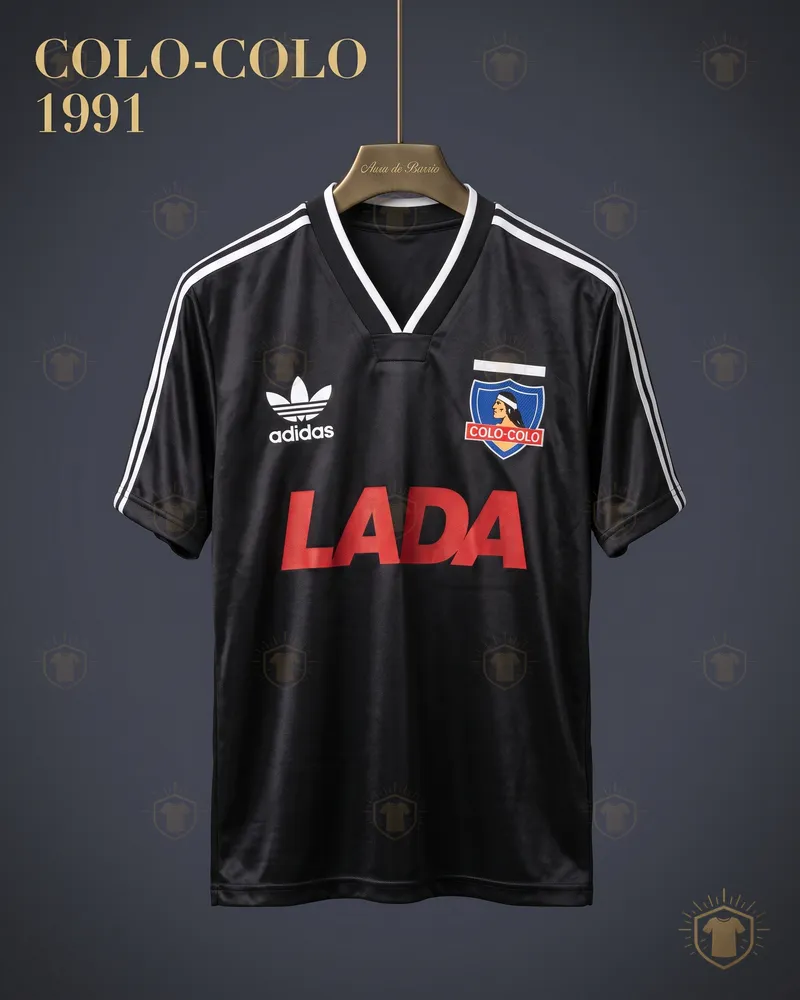
Shirts from those years
From the same era. Not necessarily the one worn that day.
Verified sources
10 sources consulted
- Website. Spanish Wikipedia, “Final de la Copa Libertadores 1991” View source
- Website. English Wikipedia, “1991 Copa Libertadores finals” View source
- Website. RSSSF, “Copa Libertadores 1991” View source
- Newspaper or magazine. Cooperativa.cl, “10 inolvidables partidos que le entregaron a Colo Colo la Copa Libertadores en 1991”, June 5, 2014 View source
- Website. RedGol, “31 años de la Copa Libertadores 1991: estadísticas del Colo-Colo que conquistó América”, June 5, 2022 View source
- Website. Goal (Chile), “Copa Libertadores: ¿cuándo y cuántas veces salió campeón Colo Colo?” View source
- Website. Revista 4-4-2 (Perfil), “La increíble historia del perro policía que mordió a Navarro Montoya en un Colo-Colo-Boca” View source
- Website. RSSSF, “Chilean Clubs in South American Tournaments 1991-2001” View source
- Website. RedGol, “Los campeones de América: el plantel de Colo-Colo en la Libertadores de 1991”, June 4, 2020 View source
- Website. Al Aire Libre, “Colo Colo y Boca Juniors: aniversario de un partido histórico e inolvidable” View source
Keep exploring
- TeamsSee the Colo-Colo page →
- The stadiumEstadio Monumental David Arellano →
- May 25, 1967 · CelticLisbon 1967: the Glasgow lions who conquered EuropeOn May 25, 1967, with goals from Tommy Gemmell and Stevie Chalmers, Jock Stein’s Celtic came from behind against Helenio Herrera’s Inter in the final in Lisbon and became the first British club to be crowned champions of Europe.
- July 30, 1966 · InglaterraWembley 1966: the day England became world championsOn July 30, 1966, with a Geoff Hurst hat-trick and a goal still debated today, England beat West Germany 4-2 at Wembley to win their only World Cup.
- May 20, 1998 · Real MadridAmsterdam 1998: Real Madrid's SeventhOn May 20, 1998, a goal by Predrag Mijatović against Juventus brought the European Cup back to Real Madrid after a 32-year wait.
- July 2, 2008 · Liga Deportiva Universitaria de QuitoLDU Quito 2008: the Cup that reached EcuadorWith a 4-2 win in Quito and a night of penalties at the Maracanã, Liga Deportiva Universitaria became the first Ecuadorian club to win the Copa Libertadores.