
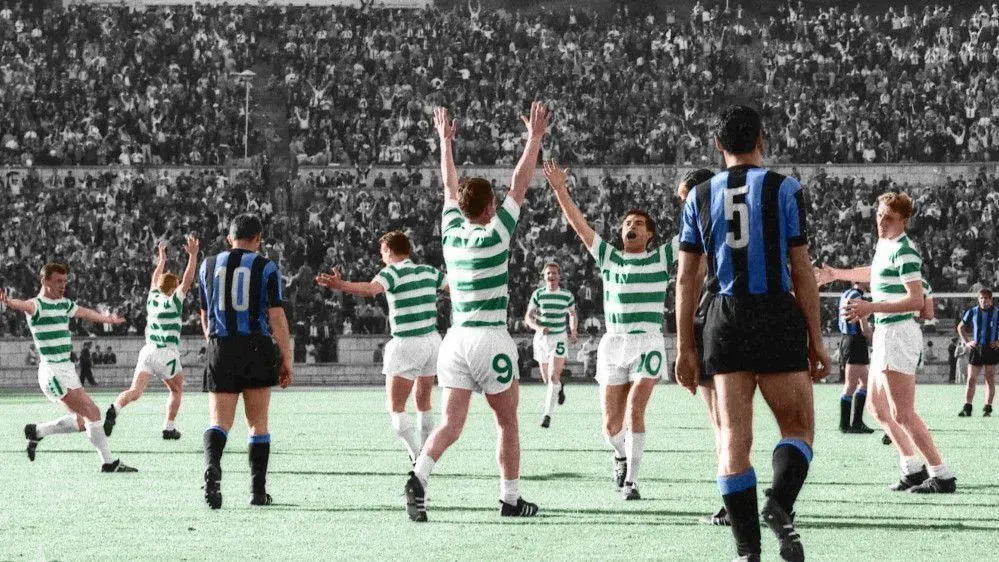
Photo: The Society Pages · Author's permission · Source
May 25, 1967 · Celtic
Lisbon 1967: the Glasgow lions who conquered Europe
On May 25, 1967, with goals from Tommy Gemmell and Stevie Chalmers, Jock Stein’s Celtic came from behind against Helenio Herrera’s Inter in the final in Lisbon and became the first British club to be crowned champions of Europe.
- Date of the event:
On May 25, 1967, at the Estádio Nacional in Lisbon, a team from Glasgow beat Inter Milan 2-1 – the two-time European champions and favourites in almost everyone’s eyes – and lifted the European Cup. Celtic thus became the first British club to be crowned champions of the continent. Their eleven starters have been remembered ever since by a name of their own: the Lisbon Lions.
Photo: The Guardian · Author's permission · Source
The return of Jock Stein
The story begins two years earlier. In March 1965, Jock Stein came back to Celtic Park, this time as manager. He arrived with a strong reputation, having lifted Dunfermline Athletic and after a spell at Hibernian. That same year, 1965, he gave Celtic their first trophy with him in the dugout, the Scottish Cup, winning the final against none other than Dunfermline, his former club.
Stein did not need to go out and buy stars. Much of the squad was already at the club and had grown up in the surrounding area. The fact is famous: all eleven who played in Lisbon were born within 30 miles, about 48 kilometres, of Celtic Park. The one who came from furthest away was Bobby Lennox, born in Saltcoats, right on that limit.
Photo: Celtic.com · Author's permission · Source
Eleven Glasgow neighbours
In goal was Ronnie Simpson. The full-backs were Jim Craig and Tommy Gemmell, and in the centre of defence played captain Billy McNeill and John Clark. In midfield, Bobby Murdoch and Bertie Auld ran the game. Up front, Jimmy Johnstone linked up with Willie Wallace, Stevie Chalmers and Bobby Lennox in an attack that never stopped moving.
Photo: The Society Pages · Author's permission · Source
The road to Lisbon
Celtic made their European Cup debut on September 28, 1966 with a 2-0 win over FC Zürich in Glasgow, with goals from Gemmell and Joe McBride. In Switzerland they won 3-0, with two more goals from Gemmell. In the second round they beat Nantes 3-1 in France and repeated the 3-1 at home.
The quarter-finals were the toughest test. In Novi Sad, Vojvodina won 1-0, Celtic’s only defeat of the entire tournament. The return leg in Glasgow stood at 1-0, thanks to a Chalmers goal, when in the last minute McNeill scored the 2-0 that turned the tie around. In the semi-final against Dukla Prague, Johnstone and Wallace, with two goals, gave them a 3-1 win at home. In Prague the team held firm and earned a 0-0 draw that was worth a place in the final.
Facing the great Inter
Waiting on the other side was Helenio Herrera’s Inter, the great symbol of catenaccio, a closed, highly organised defence that defined an era. With that style the club had already won two European Cups, and on the way to Lisbon they had knocked out Real Madrid. It was a team of stars: Giacinto Facchetti, Tarcisio Burgnich, Armando Picchi, Mario Corso and Sandro Mazzola. However, they reached the final without their playmaker, the Spaniard Luis Suárez, who was injured.
The final
Around 45,000 people filled the Estádio Nacional, with the German Kurt Tschenscher refereeing. The match began the way Inter wanted. In the opening minutes the referee awarded a penalty for a foul by Jim Craig on Renato Cappellini, which the defender always denied, and Mazzola converted it to make it 1-0.
From then on, Celtic took control of the ball. They attacked down the flanks, shot again and again, and ran into goalkeeper Giuliano Sarti and a defence that gave nothing away. The equaliser came on 63 minutes: Craig, who had been blamed for the penalty, received the ball on the right and laid it back for Gemmell, who unleashed a thunderous shot from outside the box. In the closing stages, Murdoch tried his luck from distance and Chalmers deflected the ball out of Sarti’s reach to make it 2-1. The players later said they had rehearsed that move.
Inter, one of the best teams of their era, had no answer. That afternoon took nothing away from what they had achieved, but it showed that attacking football could also beat the best defence in Europe.
A cup presented in the stand
When the final whistle blew, thousands of Scottish fans invaded the pitch. Some players were left without their shirts, and the cup could not be presented on the field: McNeill had to climb up to the stand to receive it. Shortly afterwards, the Scot Bill Shankly, manager of Liverpool, greeted Stein with a line that went down in history: “John, you’re immortal now.”
A perfect season
The European Cup was the crowning moment of a historic season. In October 1966 Celtic won the League Cup, 1-0 against Rangers, and shortly afterwards the Glasgow Cup, 4-0 against Partick Thistle. In April 1967 they lifted the Scottish Cup against Aberdeen, and the league was secured with a 2-2 draw at Ibrox, Rangers’ ground. With Lisbon, that made five titles in a single season: the league, the Scottish Cup, the League Cup, the Glasgow Cup and the European Cup.
What came next
As champions of Europe, Celtic played the Intercontinental Cup against Racing Club de Avellaneda. They won 1-0 at Hampden Park with a McNeill goal and lost 2-1 at El Cilindro in Avellaneda, so there was a play-off on November 4, 1967 at the Estadio Centenario in Montevideo. Racing won it with a strike from Juan Carlos Cárdenas, in a very violent match that ended with several players sent off from both teams.
In Scotland, Stein’s team kept on winning: they went on to win nine consecutive league titles. In 1970 they reached another European Cup final, at the San Siro stadium in Milan, and once again Gemmell stepped forward, scoring the first goal. But Feyenoord equalised and won 2-1 in extra time.
A neighbourhood legacy
Lisbon never left Celtic Park. A stand bears the name of the Lisbon Lions, and outside the stadium there are statues of Stein and of McNeill, the latter holding the cup aloft. In 2017, 50 years after the final, the supporters covered the whole stadium with a mosaic in tribute to that team and won the FIFA The Best Fan Award. More than half a century later, the idea remains intact: a group of lads born a few kilometres from their ground was able to conquer Europe.
Timeline
Jock Stein takes over as Celtic manager.
Celtic make their European Cup debut with a 2-0 win over FC Zürich in Glasgow.
Celtic beat Vojvodina 2-0, with a last-minute goal from Billy McNeill, and reach the semi-finals.
A 0-0 draw against Dukla in Prague: Celtic qualify for the final.
Final in Lisbon: Celtic beat Inter 2-1, with goals from Tommy Gemmell and Stevie Chalmers, and become the first British club to be crowned champions of Europe.
Racing Club win the Intercontinental Cup play-off 1-0 in Montevideo.
Celtic lose the European Cup final 2-1 to Feyenoord in Milan, after extra time.
Verified sources
10 sources consulted
- Website. UEFA, “Celtic Lisbon Lion Tommy Gemmell passes away”, March 2, 2017 View source
- Website. UEFA, “Stein saluted by Celtic faithful”, September 11, 2005 View source
- Website. English Wikipedia, “Lisbon Lions” View source
- Website. English Wikipedia, “1967 European Cup final” View source
- Website. FourFourTwo, “In their own words: How Celtic's Lisbon Lions shocked 'unbeatable' Inter in 1967”, May 25, 2017 View source
- Website. Spanish Wikipedia, “Copa Intercontinental 1967” View source
- Website. Scottish Football Museum, Hall of Fame, “Lisbon Lions” View source
- Website. RSSSF, “European Champions' Cup 1966-67 – Details” View source
- Website. UEFA, “1966/67: Chalmers strikes late as Celtic win in Lisbon”, European Cup history View source
- Website. English Wikipedia, “Jock Stein” View source
Keep exploring
- TeamsSee the Celtic page →
- The stadiumCeltic Park →
- June 5, 1991 · Colo-ColoColo-Colo 1991: the night Chile won its only Copa LibertadoresOn June 5, 1991, with two goals from Luis Pérez and one from Leonel Herrera, Colo-Colo beat reigning champions Olimpia 3-0 at the Monumental and won the only Libertadores ever claimed by a Chilean club.
- July 30, 1966 · InglaterraWembley 1966: the day England became world championsOn July 30, 1966, with a Geoff Hurst hat-trick and a goal still debated today, England beat West Germany 4-2 at Wembley to win their only World Cup.
- May 20, 1998 · Real MadridAmsterdam 1998: Real Madrid's SeventhOn May 20, 1998, a goal by Predrag Mijatović against Juventus brought the European Cup back to Real Madrid after a 32-year wait.
- July 2, 2008 · Liga Deportiva Universitaria de QuitoLDU Quito 2008: the Cup that reached EcuadorWith a 4-2 win in Quito and a night of penalties at the Maracanã, Liga Deportiva Universitaria became the first Ecuadorian club to win the Copa Libertadores.